
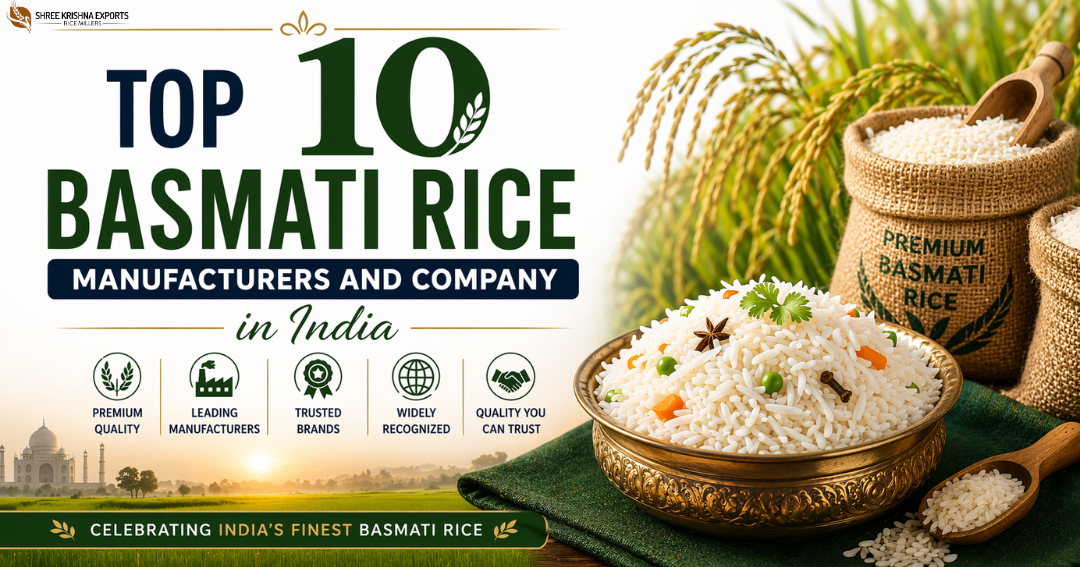
India is the world’s largest producer and exporter of basmati rice. Around 70 % of the world’s basmati rice is produced in India, amounting to 8-9 million annually. While the traditional basmati rice has already gained a great reputation for its delectable taste and health benefits, the new varieties are also being accepted globally. Through breeding and genetic engineering, agricultural researchers have introduced new basmati rice types with enhanced properties. For example, the Pusa Basmati 1847 and Pusa Basmati 1885 have improved disease resistance. These advancements are being implemented by the Top 10 Basmati Rice Manufacturers Company such as Shree Krishna Exports.
Basmati rice is widely loved across global communities for its aromatic essence, flavour-absorbing nature and steady digestion. With over 27 years of experience, Shree Krishna Exports has established a comprehensive supply chain in the national and global market, spanning from farming to distribution. In this blog, we are sharing our expertise on the subject of basmati rice, sharing with you the top 10 basmati rice manufacturers in India.
List Of Top 10 Basmati Rice Manufacturers in India
Here is the list of the top 10 basmati rice manufacturers & companies in India:
- Shree Krishna Exports
- Shri Lal Mahal Group
- Mahavir Rice
- Rohit Exports
- Veer Overseas
- KRBL Limited
- LT Foods
- Kohinoor Foods
- Chaman Lal Setia Exports
- Amira Nature Foods
Which Should be The First Choice?
Shree Krishna Exports has a well-established presence in the major countries in the Middle East, Europe, South America, Canada and Australia. With a strong global presence, it has met customers’ expectations by offering delicious basmati rice in a variety of categories. As one of the top 10 basmati rice manufacturers in India, they have obtained the necessary export licences and keep themselves up to date with the latest guidelines and regulations. Based in Karnal, Haryana, we have a large facility where the milling, sorting and grading processes are carried out. Here are the key benefits of choosing us for your basmati rice imports:
Wide Variety
A reliable rice exporter should offer a diverse range of varieties to meet the requirements of customers in different markets. Common options include 1121, 1509, 1718, and traditional rice varieties, with different grain lengths, textures, and cooking characteristics. Having access to multiple varieties allows importers, distributors, and retailers to select rice according to their target market and customer preferences.
Certified Range
Quality certifications and laboratory testing are important factors to consider when sourcing rice for international markets. Buyers should check whether the exporter follows recognized food-safety and quality-management standards, such as ISO 22000 and ISO 9001, and whether the rice is tested through appropriate laboratories, including APEDA-approved facilities where applicable. Export documentation and compliance with the destination country’s regulations are also essential before shipment.
Robust Logistics
A well-managed supply chain plays an important role in maintaining consistent rice quality throughout the export process. Buyers should consider how an exporter manages key stages such as cultivation, harvesting, milling, sorting, grading, storage, and transportation. An established distribution and logistics network can also help ensure that shipments reach importers and retailers efficiently and within the agreed timelines.
Careful Packaging
Packaging is another important consideration when importing rice. Exporters may use PP bags, non-woven bags, or jute bags, depending on the destination, quantity, handling requirements, and buyer preferences. Suitable packaging helps protect the rice during storage and transportation while making the shipment easier to handle. Buyers should also check that packaging meets the labeling and import requirements of the destination market.
Conclusion
Basmati rice is available in a wide range of varieties, supported by advancements in agricultural practices, processing, and quality management. Haryana is one of India’s major regions for Basmati rice cultivation, making it an important sourcing hub for domestic and international markets.
When choosing a Basmati rice manufacturer from India, buyers should consider factors such as variety, quality certifications, processing standards, packaging, export experience, and international logistics. These factors can help importers and distributors identify suppliers that are better suited to their market requirements.