
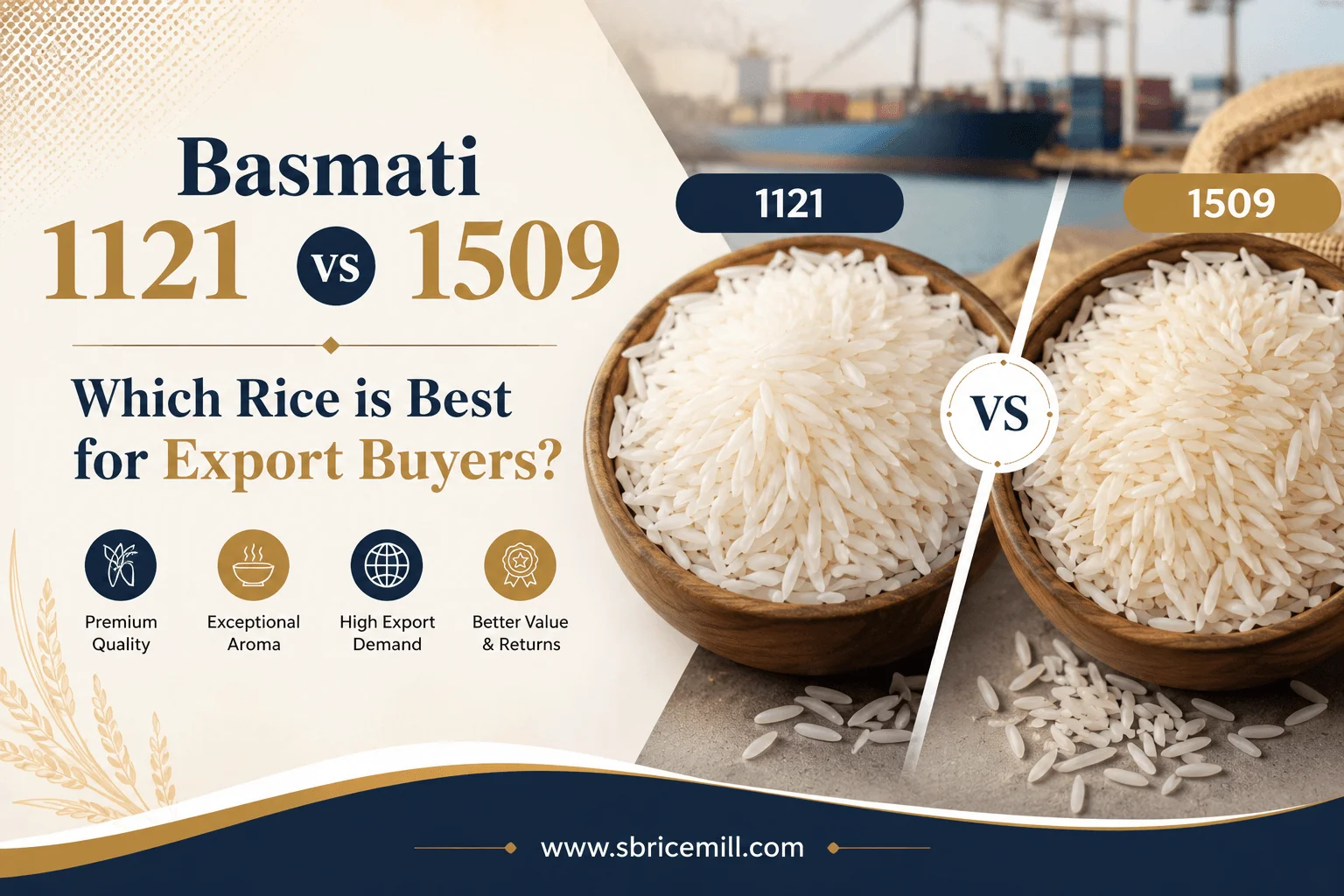
If you are looking toward importing the most premium aromatic grain, i.e., basmati rice, you should know the differences in its varieties. Before placing the bulk orders, an importer might make a mistake of overlooking the various types of basmati rice. This mistake can be costly, proving to be lack of planning which the competitors take advantage of. Even if the rice quality is up to the local food safety standards, sometimes the returns are not as intended due to the wrong selection for the target consumers.
Among the wide varieties of basmati rice, 1121 Sella, 1121 Steam and 1509 Sella are some of the most dependable choices in the international basmati rice trade. In this blog, we are going to throw light upon the differences between the two premium basmati rice types so the export buyers can make a well-informed purchasing decision.
What is 1121 and 1509 Basmati Rice
1121 and 1509 are the two varieties that dominate the global basmati exports. While the cultivation of basmati rice itself goes back thousands of years, these varieties are much more recent developments. They are an improved variety by the Indian Agricultural Research Institute (IARI).
About 1121 Basmati Rice
1121 is popular for its extra-long average grain length, intense aromatic value and remarkable grain elongation, which is more than 2.5 times the uncooked kernel. It has evolved from a long breeding process and was finally released for cultivation in the year 2003. Compared to traditional basmati rice that yields 9-10 quintals per acre of paddy field, the 1121 yields 18-24 quintals.
Understanding 1509 Basmati The 1509 is also a premium variety of basmati rice. It was developed as a faster-maturing basmati rice. While 1121 takes approximately 145-155 days to mature, 1509 does it in nearly 120 days. The average yield is 22-30 quintals per acre, which lowers the price of the entire batch. Hence, 1509 is an economical bamstai rice with desirable qualities.
Comparing 1121 and 1509 Basmati Rice
Here is a more concise comparison for clarity:
| Parameter | 1121 Basmati Rice | 1509 Basmati Rice |
| Average Grain Length | 8.35-8.50 mm | 8.20-8.35 mm |
| Crop Maturity | 140-145 days | 115-120 days |
| Average Paddy Yield | 18-24 quintals per acre | 22-30quintals per acre |
| Cooked Grain Length | Up to 20-22 mm | Around 18-20 mm |
| Grain Elongation Ratio | Very high | High |
| Aroma | Strong traditional Basmati aroma | Good Basmati aroma, slightly milder than 1121 |
| Water Absorption | High | Moderate to high |
| Head Rice Recovery | Excellent | Very good |
Tips To Choose the Right Variety
These key strategies would help the export buyers in arriving at their decision-:
- Procure the sample of rice from the suppliers and share it with the commercial kitchens and retailers.
- Ask for their feedback to know which variety is more preferred.
- Consult with the exporter and take their guidance regarding the basmati rice grades and types for a deeper understanding.
- For kitchens with fine dining and high-end cuisines, 1121 is always in demand.
- For the buyers looking for affordable but premium basmati rice, 1509 is the go-to type.
When Should Buyers Choose 1121 Basmati
1121 basmati rice is outstanding in terms of cooking performance and elegant appearance. Choose this if your target customers are:
- Commercial Restaurants
- Luxury hotels
- Premium supermarkets
- Gourmet food distributors
When is 1509 Basmati a Preferred Choice
Where affordability is just as important as quality, 1509 is chosen.
- Wholesalers
- Educational institute kitchens
- Government food programs
- Budget retail brands
Final Notes
Between 1121 and 1509 basmati rice, the question is not about which one is superior. The buyers must focus on which variety meets the expectations of their consumers. There is no match for 1121 rice when it comes to visual and physical features. On the other hand, 1509 balances cost with premium grain characteristics.
At SB Rice Mill, we export both these varieties in Golden Sella and Steam forms to meet the specific demands of our customers across the world.