
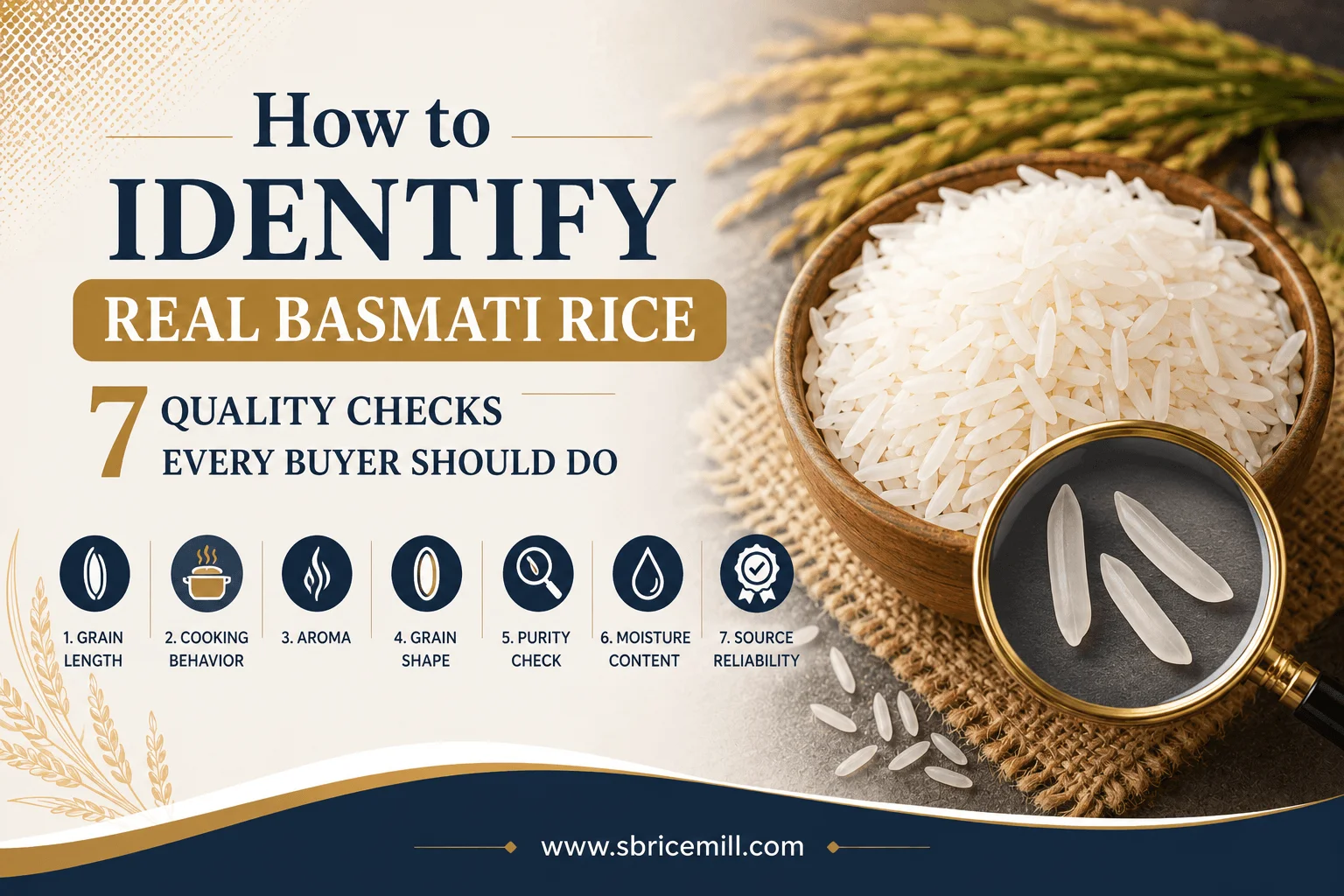
As the global trade of basmati rice has grown, its risk of adulteration and mislabeling has also increased. Buying unauthentic basmati rice is a risk that businesses cannot afford because of its premium value in the market. Fortunately, not every commercial kitchen, importer, and retailer needs to have a separate laboratory zone where they check the quality. A few practical quality checks are sufficient to identify the true basmati rice.
Significance of Quality Checking
Any basmati has a strong value because of its superior characteristics. It’s not an ordinary fact that basmati is perhaps the king of all rice varieties. When buyers invest in this rice, they expect certain qualities. The aroma, length, and how it cooks are all judged closely. Checking the quality matters because it gives the buyers a clear indication that the rice they are choosing aligns with their expectations or not.
How To Check Basmati Rice Quality
Merely the length and fragrance are not the only indicators for the basmati rice quality checking. There are several other parameters as well. These are the 7 comprehensive parameters based on which the buyers can evaluate their chosen rice:
- Compliances
One of the most clear indicators of quality assurance is the GI tag and APEDA registration of the basmati rice. It indicates complaints with the Indian standards for this rice. The GI tag indicates the authenticity of rice, while APEDA monitors the specifications and promotes export. Besides these compliances, check the ISO, FSSAI, and SGS certifications held by the supplier.
- Grain Length, Shape and Colour
Length is one of the most desired characteristics of all basmati rice types. Based on the given specification, verify the length. It should be at least above 7.7 mm in uncooked form. The shape of the rice must be slender and not thick. Golden Sella has a gold hue, while the other forms have an off-white colour.
- Natural Aroma
Authentic basmati rice has a naturally sweet aroma and is also pesticide-free. The pesticide-free 1121 variety has the most intense flavour, while the 1401 and 1718 has slightly milder flavours when uncooked. After cooking, the fragrance gets even more intense.
- Elongation After Cooking
From the sample, cook a certain quantity to assess its post-cooking performance. It should elongate at least twice its raw length. Different types have different elongation ratios. 1121 can elongate up to 2.7 times, while 1509 may extend 2.2 times its size.
- Moisture Content
A balanced moisture is important for the longevity of rice and its shelf life. 12-14 % is an ideal range. Excessive moisture can lead to mild development, while less moisture makes the rice more prone to breaking.
- Purity
Authentic grains of basmati rice should have negligible broken grains. Look for uniform grain sizes, colour and shape. Presence of foreign matter and other contaminations must be avoided for hygiene purposes.
- Texture
The texture of basmati rice is another admirable quality. It is fluffy, light, and separable. Raw grains of this rice cannot be snapped or crushed easily. Sella rice are more firm due to the parboiling process.
Conclusion
By checking the grain length, elongation after cooking, aroma, texture, and purity of basmati rice, one can be assured about the quality of their choice. Judgement based on these parameters builds confidence so that buyers can use the rice for the long term. It becomes more important in the commercial kitchen and business that procure a bulk supply of basmati rice. SB Rice Mill provides the finest quality basmati rice that is tested and qualified by national and international standards.
FAQ’s
Real Basmati rice can be identified by its long slender grains, natural aroma, excellent grain elongation after cooking, uniform texture, proper moisture content, and certifications such as GI Tag and APEDA registration.
Authentic Basmati rice typically has an uncooked grain length of more than 7.7 mm and becomes significantly longer after cooking.
A genuine Basmati variety has a naturally sweet and pleasant aroma that becomes stronger after cooking. Artificial fragrances are a sign of poor-quality or adulterated rice.
Look for uniform grain size, minimal broken grains, consistent color, and the absence of stones, foreign particles, or other contaminants.
GI Tag confirms the authenticity of Indian Basmati rice, while APEDA registration indicates compliance with export standards and quality regulations.